

Description
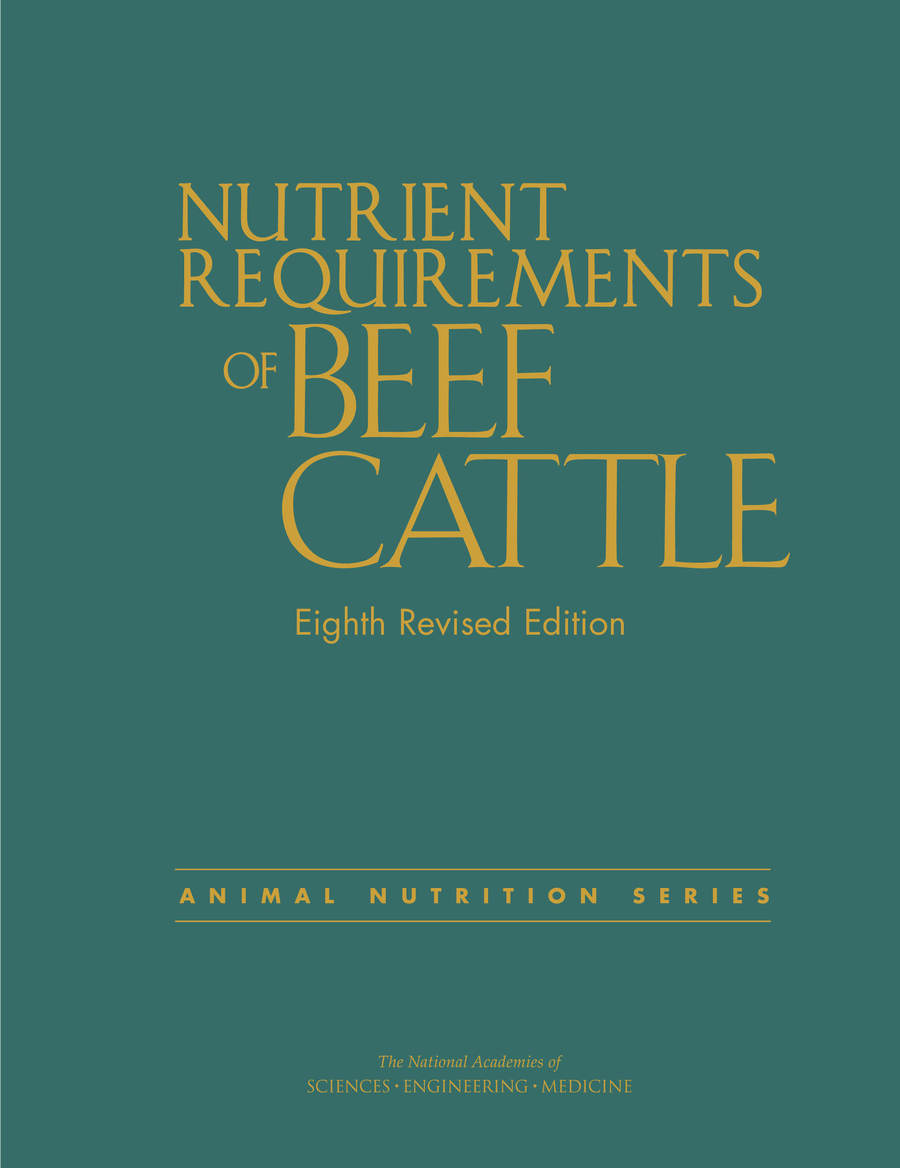
The 8th revised edition of the Nutrient Requirements of Beef Cattle was released on May 16, 2016 after 39 months in the making. This revision represented a substantial update, reflecting nearly two decades of new experimental data, advances in animal nutrition science, and improvements in quantitative modeling approaches. During this period, significant progress had been made in understanding nutrient metabolism, feed utilization efficiency, and the interactions among diet, animal physiology, and the production environment. As a result, a large body of new information across multiple nutrients and production stages required systematic documentation, critical evaluation, and integration into a coherent framework.
Several new chapters were introduced in the 2016 revision to address gaps in earlier editions and to better align the publication with contemporary beef production systems. These additions included chapters on U.S. beef cattle production systems; anatomy, digestion, and nutrient utilization; carbohydrates; lipids; and environmental factors affecting nutrient requirements. Collectively, these chapters expanded the scope of the publication beyond traditional requirement tables, placing greater emphasis on biological mechanisms, variability among animals, and the influence of management and environmental conditions on nutrient use and performance.
A major advance of the 2016 edition was the formal transition from static requirement tables toward a more mechanistic, model-based framework. The publication incorporated predictive equations and system-level concepts that allow nutrient requirements to be estimated as a function of animal characteristics, diet composition, intake, and environmental stressors. This approach improved the flexibility and applicability of the recommendations across diverse production scenarios, including grazing and confined systems, and provided a scientific foundation for computer-based decision support tools used by researchers, nutritionists, and producers.
Since 1944, the National Research Council (NRC) and its successor, the National Academies of Sciences, Engineering, and Medicine (NASEM), have published seven prior editions of the Nutrient Requirements of Beef Cattle. The 2016 revision builds directly on this long-standing legacy, synthesizing historical knowledge with contemporary research to deliver the most comprehensive and scientifically rigorous assessment of beef cattle nutrient requirements to date. In doing so, it established a modern reference point for beef cattle nutrition, supporting both applied ration formulation and ongoing research into improving efficiency, sustainability, and animal well-being in beef production systems.
Revision History (Tedeschi et al., 2019):
- Origins (1945). The Nutrient Requirements of Beef Cattle originated with the publication of the Recommended Nutrient Allowances for Beef Cattle in 1945 by the NRC. Early recommendations were largely empirical, relying on feeding trials and observed animal performance to define nutrient allowances.
- Early revisions and conceptual transition (1950–1958). The first revision was released in 1950, followed by the second revision in 1958, when the publication title changed from Recommended Nutrient Allowances to Nutrient Requirements. This transition reflected a shift toward biologically grounded requirement concepts, with particular emphasis on dietary protein concentrations to support growth and production.
- Expansion of experimental foundations (1963). The third revision, published in 1963, coincided with increased use of digestion and metabolism trials. Although nutrient requirements continued to be expressed largely as dietary concentrations, this edition reflected growing understanding of nutrient utilization and animal response variability.
- Adoption of net energy systems (1970). The fourth revision in 1970 introduced the net energy system for beef cattle, driven by advances in metabolism research during the 1960s. This represented a major conceptual milestone by partitioning energy requirements among maintenance, growth, and production functions.
- Refinement of energy and protein concepts (1976–1984). The fifth revision, released in 1976, continued refinement of energy requirements, while the sixth revision in 1984 introduced major advances, including improved energy requirement calculations and the formal incorporation of ruminal protein degradation and bypass protein concepts. These changes reflected increased attention to rumen function and efficiency of nutrient use.
- Mathematical description of rumen function (1985–1989). During the 1980s, advances in rumen microbiology and metabolism led to mathematical descriptions of rumen fermentation, which were incorporated into NRC frameworks. The factorial method became central to computing protein requirements, further advancing biological realism in requirement estimation.
- Mechanistic modeling era (1996, 2000). The seventh revision, published in 1996 and updated in 2000, marked a transformative shift toward mechanistic, equation-based nutritional models. Enabled by digital computing and extensive experimental databases, this edition introduced equations to predict nutrient requirements for maintenance, growth, pregnancy, lactation, rumen fermentation, intestinal digestion and absorption, and metabolism. A companion computer model operationalized these concepts, allowing dynamic evaluation of nutrient supply and animal performance beyond static tables.
- Systems integration and sustainability emphasis (2016). The Eighth Revised Edition, released in 2016 by the National Academies of Sciences, Engineering, and Medicine, built upon the 1996/2000 framework by incorporating advances in systems modeling, feed evaluation, and environmental assessment. This edition further refined protein degradation kinetics, energy partitioning, and intake prediction, while emphasizing improved precision in nutrient use, reduced reliance on conservative safety factors, and enhanced alignment with environmental sustainability goals, including reductions in nitrogen, phosphorus, and greenhouse gas excretion.
Across successive editions, the Beef NRC evolved from empirically derived feeding guidelines to integrated, mechanistic decision-support systems. Progressive improvements in biological representation, computational capability, and data integration have strengthened the accuracy of requirement prediction, reduced production costs, and supported environmentally responsible beef production under diverse management conditions.

Click here to start a tutorial on how to use the Beef Cattle Nutrient Requirement Model (BCNRM, 2016).

Download
|
|
|
|
Microsoft Excel 2007 or later versions |
|
The “Beef Cattle Nutrient Requirements Model 2016.EXE” is a stand-alone software that will install the Beef Cattle Nutrient Requirements Model (BCNRM) on Windows-based computers. The BCNRM requires Microsoft Excel 2007 or later versions to be executed. The user must have administrative privileges to install the BCNRM. A computer with the following configuration is suggested for satisfactory performance: 2 GHz Intel Core Due (or similar) with at least 2 Gb of RAM. A CD/DVD-ROM for installation from CD media, an IBM-PC compatible printer to print reports, and an internet connection for updating and registration. From the BCNRM User's Guide: "The BCNRM of the Nutrient Requirements of Beef Cattle, 8th Revised Edition, was developed using the Microsoft® Excel® 2016 (version 16) electronic spreadsheet of the Microsoft Office 2016 to demonstrate the use of the empirical (ELS) and mechanistic (MLS) levels of solution in the calculations of the dietary supply and requirements of beef cattle for energy and nutrients, which are discussed in detail in Chapter 19 (Model Equations and Sensitivity Analyses). A basic understanding of the operations of the Microsoft® Excel® is necessary to execute the computer software. Similarly, an understanding of ruminant nutrition and knowledge of the underlying biological concepts presented in this report are essential for use and interpretation of the model’s results. Because of the many variables involved and judgments that must be made in choosing inputs and interpreting outputs, the National Academies of Sciences, Engineering, and Medicine make no claim for the accuracy of this software and the user is solely responsible for risk of use." |
|||




The current version of the 2016 Beef Cattle Nutrient Requirements Model is Loading...
 Note that upgrading to this version may require uninstalling an earlier version.
Previous versions can be downloaded from here.
Please note that this version is experimental and might be different from the release version. The National Academies of Sciences, Engineering, and Medicine contains the release version.
Changes to the BCNRM software are listed in this text file. The official errata to the Nutrient Requirements of Beef Cattle publication can be found in its website. See Support below.
Registration
No registration is needed for the current version. Nonetheless, you are welcome to submit your comments to improve this model at the Contact us web page.
Developers
|
SUBCOMMITTEE ON THE 2016 BEEF CATILE NUTRITION: |
|
 |
|
|
Back row (left to right):
|
Front row (left to right):
|
Support
The following list summarizes corrections, enhancements, and functional improvements made to the software, presented in chronological order (newest to oldest). Each entry reflects updates implemented to improve stability, usability, and overall performance.
August 2026. No modifications or corrections were performed in the Beef NASEM (2016) computer model (BCNRM). In the update (v. 1.0.37.26), we revised the number formatting used by the SAVE and LOAD functions from fixed-decimal numeric formatting to a general numeric format. This change preserves the full numerical precision of stored values, avoiding unintended rounding or loss of decimal places when data are saved and subsequently loaded.
January 2026. No modifications or corrections were performed in the Beef NASEM (2016) computer model (BCNRM). In the update (v. 1.0.37.24), we improved the robustness and usability of the software infrastructure, particularly when BCNRM is accessed from cloud-synchronized storage locations (e.g., OneDrive), by resolving file path handling and file-system compatibility issues. In this update (v. 1.0.37.25), we resolved the “can’t find project or library” error that occurred on computers without Palisade @RISK/RiskXLS installed by removing the invalid @RISK (Risk.xla / Palisade_Risk_XDK8) reference and making the dependency optional.
December 2025. No modifications or corrections were performed in the Beef NASEM (2016) computer model (BCNRM). In this update (v. 1.0.37.23), we modified how the BCNRM checks for available updates on the www.nutritionmodels.com website, updated the default configuration files by assigning 100% efficiency to the conversion of rumen degradable protein (RDP) to microbial crude protein (MCP), removed an unnecessary dynamic-link library (DLL) from the installation package, and revised the installer to reflect these changes.
March 30, 2025 This update (v. 1.0.37.22) corrected the calculation of the number of days required to gain or lose one body condition score (BCS) by properly accounting for the efficiency of using body reserves for maintenance (km), ensuring correct conversion of net energy from body reserves to metabolizable energy. In response to user feedback, a new setting was also introduced allowing users to include the metabolizable energy (ME) and metabolizable protein (MP) requirements associated with target average daily gain (ADG) for lactating and dry cows in the nutrient balance. While the model has always computed target ADG and its associated requirements, these were previously excluded from ME and MP balance calculations for non-growing animals. Including target ADG in the balance provides a more complete accounting of nutrient requirements when cows are expected to gain weight and may result in more conservative, biologically realistic estimates of ME- and MP-allowable milk production. At the same time, uncertainty remains regarding how animals partition available nutrients among growth, body reserves, and milk production, so this option is provided to support alternative modeling assumptions without altering the core equations.
April 8, 2024. This update (v. 1.0.37.21) corrected the nitrogen-to-sulfur (N:S) ratio calculation to ensure consistency with established nutritional relationships and improve the accuracy of nutrient balance assessments.
July 18, 2023 No modifications or corrections were performed in the Beef NASEM (2016) computer model (BCNRM). This update (v. 1.0.37.20) fixed issues with the automatic calculation and updating routines in the Home worksheet, improving reliability and ensuring that model outputs reflect the most current inputs.
July 8, 2023 No modifications or corrections were performed in the Beef NASEM (2016) computer model (BCNRM). This update (v. 1.0.37.19) enabled the BCNRM to automatically check for available updates at startup and revised the website reference to reflect the updated National Animal Nutrition Program (NANP) web address.
July 4, 2023. No modifications or corrections were performed in the Beef NASEM (2016) computer model (BCNRM). This update (v. 1.0.37.18) improved the formatting and refresh speed of checkbox controls in the Feeds worksheet and added a dedicated “Refresh” button to the Feeds toolbar, allowing users to manually update checkbox states more efficiently.
July 2023. No modifications or corrections were performed in the Beef NASEM (2016) computer model (BCNRM). The refreshing and formatting speed of the Feeds, Diet, and Composition screens in the BCNRM version 1.0.37.17 has been slow likely due to recent security changes adopted by Microsoft Office Excel. The issue was caused by the CheckBox control components. This problem has been addressed in the version 1.0.37.18.
January 2021. No modifications or corrections were performed in the Beef NASEM (2016) computer model (BCNRM). Microsoft Visual Basic Run-time error '1004' when attempting to open the BCNRM program in Excel. Excel will ask if the Macros should be allowed to run. Allow the macros to run. Only enable macros from trusted sources. Troubleshooting steps:
- Start Microsoft Excel
- On the Menu Bar select "File" > "[Excel] Options" > "Trust Center" > "Trust Center Settings..." > "Macro Settings"
- In the top section, select the radio button for "Disable all macros with notification"
- In the bottom section, check the box for "Trust access to VBA project object model"
- Click "OK" and "OK" to save the settings
- Close Excel
January 2019. The second errata of the Nutrient Requirements of Beef Cattle publication was issued. The official errata to the Nutrient Requirements of Beef Cattle publication can be found in its website.
November 19, 2017. The original "Batch.xlsx" had a missing model input in row 54 (Recycled ruminal N) that would cause incorrect calculations. The correct "Batch.xlsx" file can be downloaded from here.
October 2016. The first errata of the Nutrient Requirements of Beef Cattle publication was issued. The official errata to the Nutrient Requirements of Beef Cattle publication can be found in its website.
The latest revised BCNRM 2016 feed library (Beef STD 2016.FLF) can be downloaded here. Unzip the file and copy the "Beef STD 2016.FLF" file to the folder"C:\Users\[User Name]\Documents\National Academies\BCNRM2016".
The Front Matter, Summary, User's Guide of the Beef Cattle Nutrient Requirements Model 2016 can be downloaded from here.
Five webinars were produced during the official release of the NASEM Beef (2016), as follows:
- Dr. Galyean: An overview of the revised publication
- Drs. Caton, Krehbiel, Lemenager: Cattle maintenance, growth, and reproduction
- Dr. Caton and Eisemann: Protein, vitamins, and minerals
- Dr. Tedeschi: Development and evaluation of the mathematical model
- Drs. Cole, Beauchemin, and Erickson: Environmental issues, byproducts, and feed composition
Links
- National Animal Nutrition Program, National Research Support Project (NRSP-9) web site.
- 8th Revised Edition of the Nutrient Requirements of Beef Cattle web page.
- 7th Revised Edition of the Nutrient Requirements of Dairy Cattle web page.
- 2007 Nutrient Requirements of Small Ruminants web page.
- ASAS webinar on the 8th Revised Edition of the Nutrient Requirements of Beef Cattle.