

Description
The MCCGC (Modelo de Composição Corporal para Gado de Corte; i.e., Beef Cattle Body Composition Model) is a dynamic, mechanistic simulation model developed to predict how level of nutrition influences the composition of empty body gain in beef cattle, independently of body weight alone. The model is explicitly grounded in the theoretical framework proposed by Keele et al. (1992) and Williams et al. (1992), which recognized that animals of similar genotype and empty body weight can differ substantially in fatness depending on their rate of empty body gain, a proxy for nutritional plane. Rather than treating body composition as a static function of weight or age, the MCCGC represents growth as a time-dependent biological process, where lean tissue and fat respond dynamically to changes in nutritional status and maturity (Keele et al., 1992).
At its core, the model partitions empty body weight into fat-free matter (FFM) and fat, and simulates changes in these components using coupled differential equations. Growth rate (dEBW/dt) drives nutrient partitioning, but its effect is modulated by stage of maturity, represented as FFM relative to mature FFM, and by a priority coefficient (k) that governs how nutrients are allocated between lean and fat tissue. This coefficient declines as animals mature, reflecting the biological shift from lean tissue accretion toward fat deposition. The VB6 implementation exposes these concepts through parameters such as Kmax and Kmin (maximum and minimum fractional growth rates of FFM relative to empty body weight), theta (θ), which controls how strongly growth rate affects fatness, and fat-free matter mature weight (FFMMAT), which defines mature body composition for a given sex and genotype.
A defining feature of the Keele–Williams framework, preserved in MCCGC, is the treatment of nutritional effects as delayed rather than instantaneous. Sudden changes in intake do not immediately translate into changes in body composition; instead, the model introduces a lagged growth signal that smooths the response over time, capturing metabolic inertia and homeorhetic adjustment. This mechanism explains well-known phenomena such as compensatory growth, where cattle previously restricted in intake deposit lean tissue differently upon refeeding. In the MCCGC interface, this behavior is operationalized through parameters such as lambda and the lag coefficient, allowing users to simulate transitions among feeding phases with biologically realistic carryover effects (Keele et al., 1992).
|
Relationship between Empty Body Fat versus Empty Body Weight of Different Breeds Simulated by the MCCGC |
|
|
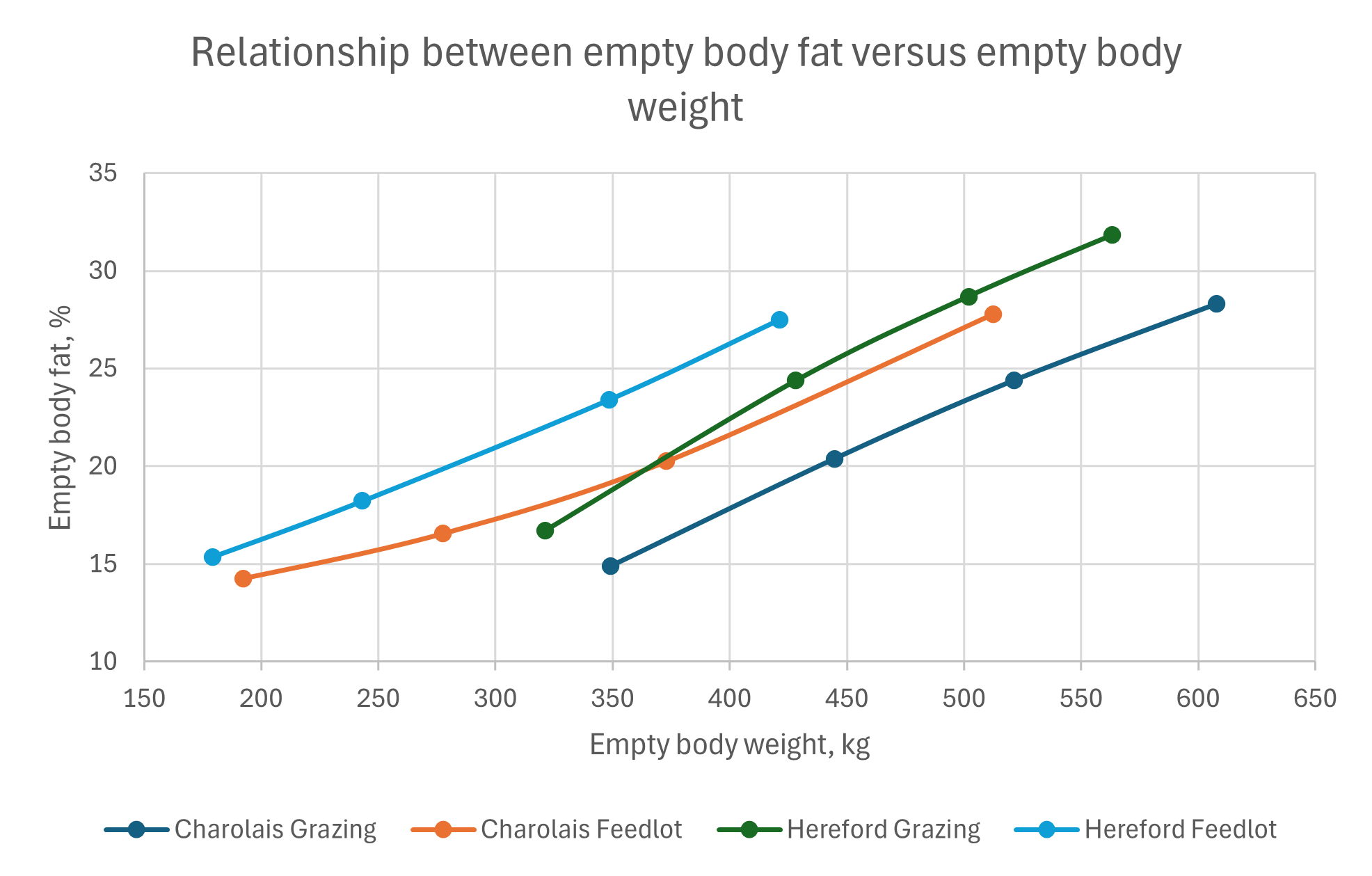
The model also incorporates the concept of body composition equilibrium, consistent with the assumption that when empty body gain approaches zero, animals asymptotically move toward a stable fat–lean composition rather than remaining static. For immature cattle, equilibrium corresponds to a minimal fat content, whereas near maturity it converges on a genotype-specific fat proportion (approximately 25% fat at mature equilibrium). This equilibrium logic is embedded in the MCCGC equations and becomes visible in simulations where growth slows or maintenance feeding is imposed. The VB6 program allows users to define finalization criteria, enabling simulations to end when a target variable—such as fat percentage or body weight—reaches a predefined threshold. From a software perspective, the MCCGC translates this theoretical model into a modular decision-support tool. Separate forms manage animal registration, growth-period definition, numerical parameter configuration, and simulation execution and visualization. A dedicated polynomial regression module supports empirical derivation of growth coefficients, mirroring the original model’s reliance on experimental data for parameterization. Results are stored, reviewed, and compared across scenarios, reflecting the evaluation philosophy articulated by Williams et al., 1992, who demonstrated that the model successfully explains a substantial portion of variation in body fatness not attributable to body weight alone, except under extreme protein limitation.
The MCCGC is not merely a growth curve program but a faithful computational implementation of the Keele–Williams body composition theory: a dynamic, nutrition-responsive model that links growth rate, maturity, and time-lagged metabolic adaptation to predict fat and lean deposition in beef cattle. Its structure anticipates many principles later embedded in modern nutritional systems, while its explicit focus on rate-driven compositional change remains scientifically distinctive and biologically insightful.

Download
|
|
|
Visual Basic 6 (SP6) |
32 bit and 64 bit Compatible |
|
MCCGC is implemented as a classic VB6, form-driven, stateful simulation application that couples a user-interface layer with a centralized computational and data-access layer. The numerical core solves a system of coupled, nonlinear first-order differential equations for empty body fat-free matter and fat using an explicit fourth-order Runge–Kutta algorithm with variable time step control, closely matching the integration strategy described in the original Keele et al. (1992) and Williams et al. (1992) model. Growth rate inputs (constant, piecewise, or curve-derived) are discretized by user-defined growth periods, and a distributed lag state variable is maintained internally to delay the effect of changes in dEBW/dt on tissue partitioning. Model parameters (e.g., Kmax, Kmin, theta, lambda, mature FFM) are exposed through configuration forms but passed as shared state to the solver module, enabling scenario sweeps without recompilation. Empirical coefficients can be generated interactively through an embedded polynomial regression utility, which computes and stores linear or quadratic parameters for reuse in simulations. Persistent storage is handled via a local DAO/Jet database, with records keyed by animal, growth period, and simulation run, allowing deterministic replay and comparison of results. Overall, the software architecture cleanly separates UI, numerical integration, parameter management, and data persistence, which was advanced for its time and well aligned with the computational demands of dynamic biological modeling in VB6. |
|||




The current version of the "Modelo de Composição Corporal para Gado de Corte" is Loading...
 Note that upgrading to this version may require uninstalling an earlier version.
Previous versions can be downloaded from here.
Registration
No registration is needed for the current version. Nonetheless, you are welcome to submit your comments to improve this app at the Contact us web page.
Developers

|
Dr. Luis O. Tedeschi
|

|
Support
The following list summarizes corrections, enhancements, and functional improvements made to the software, presented in chronological order (newest to oldest). Each entry reflects updates implemented to improve stability, usability, and overall performance.
January 2, 2026. In version 1.1.4 of the MCCGC program, the graph plotting functionality was substantially improved to make the visualization of simulation results more robust, accurate, and user-friendly. The plotting logic was restructured to correctly handle multiple simulations displayed simultaneously, ensuring that each simulation is rendered as an independent curve with its own legend entry. This required addressing specific behaviors of the Graph32.OCX control, particularly how legend text is internally associated with point indices, to prevent legends from being overwritten when additional simulations are added. Axis labels and the main graph title were also standardized and made dynamic, automatically reflecting the selected variables on the x- and y-axes to improve interpretability. In addition, the plotting workflow was stabilized to prevent residual data from previous plots from persisting unintentionally, and native Graph32.OCX export functionality was enabled to allow users to save high-quality vector graphics (WMF) of the plots directly to disk was released to improve the handling of graphical output.
Links
This section will be updated with relevant links as they are identified and curated for this model.